Two Kinds of Time
Measured Time and the Confidence of Clocks
 I live, like most people, inside two kinds of time.
The first is the kind that happens on clocks and calendars. It measures, schedules, reminds, and evaluates.
It tells me when to eat, when to sleep, when something is due, and how late I am already running.
This kind of time is practical, necessary, and relentless. It moves in straight lines and rewards efficiency.
We might call it Chronos—the time of sequence and succession—but it hardly needs a name. It governs most of modern life without explanation.
 The Moments That Refuse Scheduling
The second kind of time is harder to point to, because it refuses to be pinned down.
It arrives when it is time to watch the sunset, or when a memory surfaces without warning, or when a conversation lingers longer than planned.
It cannot be scheduled and does not respond to alarms. It is the time we inhabit rather than manage. This is often called Kairos—the right time, the ripe moment—but again, naming it matters less than recognizing it.
I am not interested in choosing one over the other. Chronos gets me to appointments. Kairos reminds me why I bothered to show up.
The trouble begins when measured time forgets its limits—when it assumes it can tell us not just when to live, but how.
When Time Falls to the Floor
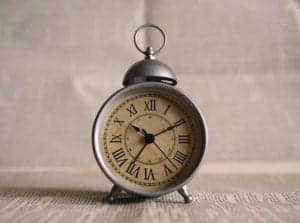
Merton knocked the clock off the windowsill this morning. This was not an accident…
Merton is the kind of cat who might be described—if cats tolerated such language—as being neurodivergent.
Intensely curious. Endlessly investigative. Drawn to trouble the way other creatures are drawn to warmth.
He chews anything that crinkles and the edges of every paper I leave unattended, as if punctuation itself were optional.
His brother, Moxie, is a much more conventional cat and appears faintly embarrassed by Merton’s approach to life.
Merton, for his part, is unapologetic.
The clock landed face down on the floor.
Silent.
For a moment, time stopped…or at least the demanding, over-organizing and scheduling of it stopped.
The Problem With Letting Time Do More Than It Can
That clock lives on the windowsill for a single purpose: to remind me that time is passing and that I should be doing something about it.
- Getting up.
- Getting moving.
- Getting on with the day.
It does not care about the quality of the morning, the slowness of the light, or the negotiations taking place between my body and my intentions.
It knows only numbers.
Merton knows none of this. He knows beds—wherever they happen to be that day—and shares them faithfully with Dekker.
He knows warmth. He knows curiosity. He knows that objects placed at the edge of things are invitations.
As I stood there holding the fallen clock, deciding whether to return it to its post, I felt the brief discomfort of an unplanned question: Who decides what time it is?
The clock, with its tidy insistence? Or the morning itself, which unfolds without reference to my plans?
I put the clock back. (I am not reckless.) But the interruption lingered. Once you notice how often you are being hurried by objects you seldom think about, it becomes difficult to unnotice it. Like clocks…
Some time is measured.
Some time is lived.
Cats, it turns out, have strong ideas about the difference.
How the Body Keeps a Different Kind of Time
Once the clock was back in place, the morning resumed its negotiations.
My body had opinions. The light was in no hurry. Nothing catastrophic happened because I paused. No one called to say I had missed my chance at the day.
This is how I am slowly learning to recognize the difference between measured time and lived time.
Chronos time—the time of clocks and calendars—is indispensable. It structures our days and keeps us in some semblance of coordination with the world.
But it is also blunt.
It cannot tell the difference between fatigue and laziness, between readiness and resistance. It does not know when grief needs more room or when joy refuses to be rushed.
Kairos time, on the other hand, invites listening.
It notices when the body begins to nod, when attention drifts, when a memory asks to be remembered.
It does not announce itself with numbers. It arrives with feelings – of now, of late, of expectation
I have spent much of my life assuming that if I could manage Chronos well enough—organize it, discipline it, master it—everything else would fall into place.
What I am learning, especially as I age, is that ‘time efficiency’ is a poor substitute for wisdom.
The Illusion We Rely On
The clock encourages the comforting illusion of control. It suggests that if we schedule carefully enough, we can outrun uncertainty, aging, even death.
But death, inconveniently, refuses to be scheduled. We know it will happen. We do not know when.
Chronos gives us the fact; Kairos holds the mystery.
Oddly, I am not sure knowing the date would help. I suspect it would make us frantic rather than faithful.
We would rush instead of listen. Accumulate instead of attend.
This tension shows up even in our notebooks and journals.
Planners ask us to account for our days. Undated journals invite us to remember them.
One tracks; the other listens.
One evaluates; the other receives. Both have their place—but only one tells the truth about what endured.
Living With Time, Not Against It
Some of the most important things in my life have never arrived on schedule.
- Love did not consult my calendar.
- Wisdom did not respect my deadlines.
- Writing—real writing—has never responded well to being bullied by the clock.
Good writing arrives when it is time, not when it is expedient.
This is not an argument against structure. It is an invitation to humility.
To recognize that some forms of knowing cannot be rushed.
That some kinds of time are meant to be entered, not conquered.
That occasionally, a cat knocking a clock to the floor is not an inconvenience but a reminder.
Some time is measured. Some time is lived.
And learning the difference may be one of the essential, yet not so obvious, tasks of a lifetime.
If this reflection resonated, you might enjoy lingering a bit longer.
I write weekly at The Reflective Pen about time, aging, memory, writing, and the quiet work of living attentively—especially in the later chapters of life.
You’re welcome to subscribe, read along,
or simply carry this question with you today:
Which kind of time am I living inside right now?

