The Pilgrimage of Aging
Walking With Intention, Lightening the Load
“I can’t control what’s happening in the world.
But I can put one foot in front of the other and walk my pilgrimage.”
— Joanna Penn
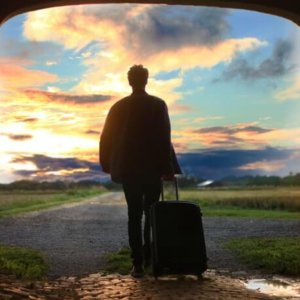 After I finished Pilgrimage, Joanna Penn’s account of walking three pilgrimages during and after the pandemic, I realized how much her physical journey mirrors our shared journey of aging.
Not in the details, of course.
But in the posture.
We cannot control what is happening in the world.
And we cannot control the fact that we will age– and eventually die.
What we can do is put one foot in front of the other and walk our pilgrimage.
The deeper question is this–What will we notice along the way?
A World We Do Not Control
One of the strengths of Penn’s writing is her attention to the landscapes and cultures she walks through—and to the people she meets briefly, sometimes only once.
Like pilgrims before her, she does not attempt to change the world she is walking through.
She learns to receive it. Even when it feels foreign. Even when it is uncomfortable. Even when it carries real danger.
That feels important to name.
Because aging, too, moves us through unfamiliar terrain.
Our culture, however, treats aging very differently.
When Aging Becomes the Enemy
If we pause long enough to notice, we see how often aging is framed as an opponent to be battled, a process to be stalled—or even reversed. We are surrounded by products, services, and philosophies devoted to resisting time itself.
This posture does a quiet violence to the human spirit.
It suggests that something natural is wrong.
That we shouldn’t accept experiences of loss that come as we grow older (teeth, hair, and strength are sometimes the least of these).
There is a belief that years subtract rather than deepen.
But what if we reimagined aging?
What if, instead of seeing it as a decline, we understood it as a pilgrimage—a sacred journey toward wisdom, perspective, and wholeness?
It’s not easy — but meaningful.
Preparation Matters on Any Pilgrimage
One thing Penn emphasizes repeatedly is preparation.
Not just packing what is necessary, but packing lightly.
That distinction matters.
There came a point in my own life when I realized I was carrying too much baggage—both literally and figuratively.
Too much to lift. Too much to justify. Too much to defend.
It is never too early to prepare for the pilgrimage of aging by lightening our load.
I’ve begun with external stuff, which is not as difficult as internal baggage. I chose to start with books.
I’ve weeded out shelves. Shifted to e-books for the ones I can’t part with. Donated others while I can still lift the boxes myself.
I know my descendants will not be interested in what I’ve read—and I would rather see these books treasured now than abandoned later.
Yes, it hurts.
But so do aching muscles after walking twenty miles in a day—or so I have been told by those fortunate enough to have that experience.
And with each box that leaves my house, I notice something unexpected.
Freedom.
The Weight We Don’t Feel Until We Do
But physical belongings are only part of the story.
The heavier baggage is harder to see.
Resentments.
Old griefs.
Rigid opinions.
Habits that once fit neatly between our joys and ambitions.
When I was younger, I didn’t feel the weight of these things. They traveled quietly. I assumed the blisters were just the cost of living.
Today, I no longer have the strength—or the desire—to carry what is not necessary.
The cost of resentment (“She got to do everything first”).
The burden of unforgiveness (“I was right, and I could prove it”).
These things blister the soul.
Some are as persistent as blackflies—always buzzing, always biting, always testing our patience. Avoiding them can feel endless.
Still, I am learning to travel lighter.
What I Refuse to Leave Behind
As the metaphor of pilgrimage continues to open itself to me, my enthusiasm grows—even with the bugs and blisters.
And I find myself asking a different question now.
Not What must I let go of? But What is essential to carry?
The first thing that comes to mind is a camera.
The miracle of photography in a phone still amazes me. I take pictures not just to remember—but to see what I missed while walking. A close-up of a bug on a leaf. The curve of a boardwalk through a bog. Even the wrinkles on my own hand, or my bare foot pressed against the earth.
My photos are not for a museum.
They help me pay attention, to be present wherever I am.
Recording the Journey
I would never set out on a pilgrimage without a journal.
For years, I championed digital journaling—and it still has its place in my life. But recently I’ve returned to pen and paper, and the shift has surprised me.
There is something about letting a pen move across fine Japanese paper that slows the body and sharpens the mind. The words arrive differently. More honestly. More patiently.
Journaling is a path I will write about another time.
For now, it is enough to say this: The act of recording our journey changes how we walk it.
Walking the Pilgrimage of Aging Together
A camera.
A journal.
A fine pen.
These feel like the essentials for any pilgrimage—especially the pilgrimage of aging.
If you could carry only three things besides the clothes on your back as you grow older, what would they be?
I suspect the answer changes with the years.
And that, too, is part of the journey.
We are not meant to walk it unchanged. I will continue this train of thought with the non-tangible things I am learning (slowly) to unload the next time I sit down to write.
Where shall I send the next TheReflectivePen for you?

