The Problem of Tears
Don’t Cry
(How Some of Us Learned to Swallow Our
Tears Before We Learned to Walk)
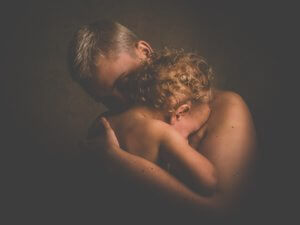
There are phrases that seem to be part of the air we breathed growing up.
Not formal teachings. Not even written rules.
Just sentences that floated through kitchens, hospitals, classrooms, and churches.
Don’t cry.
Get a grip.
Be strong.
If you grew up in New England—or in a family shaped by stoicism, survival, or quiet endurance—you probably know these words by heart. Many of us learned them so early we don’t remember learning them at all.
And yet…
Here we are, decades later, still struggling to give ourselves permission to feel what we feel.
I want to begin there.
From a time before memory is captured, a time before language, a time when wiring is still being layed down by unseen angels whose job is neurowiring, I was being shaped by an ethic that said “Do not cry, do not let feelings control you, be strong, tears are a sign of weakness, you’ll never achieve anything if you cry about it. Success comes to those who can bury the bad stuff and move on.”
In its simplest terms I was taught to ‘get a grip’ before I learned to walk.
Nevermind that the first conscious thing I did upon my entrance to this world was announce my arrival with Bah-Wah-h-h-h-h. as I dangled upside down with a doctor’s grip around my ankles.
My cry was celebrated…until it wasn’t.
Soon enough, the message shifted.
“There, there… don’t cry.”
“Be a big girl now.”
“Everything is fine, no need for tears.”
My First Tears
Those in attendance met my wails with smiles and a flurry of towels wrapping my wriggling body. Lights shone brightly, and something cold and hard pressed against my chest.
I could no longer hear a lub dub from outside of myself, but if I stayed very very quiet I could feel it from within. And the bah-wah’s made the lub-dubs beat faster and bring a lady in white.
‘Whoosh! I am swept up and find myself bouncing against a soft body and someone is pounding against my back as if they want me to let them in.
This new world has a strange way of communicating.
I miss my first bed-womb—a place of gentle comfort and silence.
My new bed-room comes and goes. But I know the password. It is Bah-wah! Works every time. Bah-wah. Bah-wah…wah-h-h-h.
I love how I can make the woman who is sitting quietly stand up.
Bah-wah-h-h-. Here she comes.
But she is taking longer and longer to arrive. Bah wah-h-h- Bah wah-h-h-h.
I feel the shove of something soft between my lips. My jaw tightens and my mouth begins sucking as if my life depends on it. I learn much later that it does.
But for this one moment, I only suck.
I let the warm fluid squirt down my throat and fill my tummy with something that feels very good.
I would like to sing my gratitude, but the only song I know is Bah-wah! For some reason, the woman must not like my anthem of praise.
She works furiously to get me to stop. It must not be a good thing in this new world in which I landed.
Soon my eyes close as if there were sandbags on them and my arms and legs relax into a state of torpor. I really want to stay awake, but I am powerless.
What Kind of World Doesn’t Celebrate Tears
What kind of world celebrates a cry—then teaches you to silence it?
One minute, these people in white celebrated the gusto of my cry, and the next, they are telling me not to do it.
Oh, how I want to return to the place of serenity I had come from— a place of warmth and rhythm.
A dark, floating room where sound was muffled, and the steady lub-dub of a heart promised safety.
Now there was light. Endless light. Cold hands. Sharp pokes.
People in white who came and went, pressing and prodding, taking blood, making notes.
When I cried, things happened. When I cried, someone came.
So I cried.
Bah-wah.
Bah-wah-h-h.
It worked—until it didn’t.
Gradually, the response slowed. The approval faded. The urgency shifted. My cry became something to manage. To quiet. To discourage.
And just like that, the lesson was planted.
1st Commandment – Thou Shalt Not Cry
Thou shalt not cry.
It’s an odd rule, when you think about it.
Everyone I have ever known has the capacity for tears.
Many cry without any obvious harm coming to them.
And yet, for some of us, crying became forbidden ground.
Not because we were told once.
But because we were told often.
And because the world rewarded us when we complied.
Strength was praised.
Control was admired.
Composure was currency.
Tears were… suspect.
Tears in Later Life
Fast-forward a few decades.
Illness arrives. Loss accumulates. Bodies change. Roles shift.
And suddenly emotions rise up that cannot be neatly filed away.
Grief. Fear. Anger. Regret.
Tenderness we don’t know what to do with.
Many people in their later years tell me some version of this:
“I don’t cry.”
“I can’t.”
“I won’t let myself.”
As if tears were a failure of character rather than a response of the nervous system.
As if we could outgrow the need to feel.
A Question Worth Sitting With
I find myself wondering:
Can a person live without tears?
Is it even healthy?
And what does it cost us to keep obeying a rule that was never designed for a lifetime?
Perhaps tears are not weakness at all.
Perhaps they are information.
A language older than words.
A body’s way of saying, Something matters here.
How one lives without tears is surely a conundrum. I question whether it is even healthy.
An Invitation (Not a Fix)
I’m not suggesting we dissolve into emotion or make tears a new moral requirement.
I am suggesting something else.
What if, instead of stopping ourselves mid-feeling, we became curious?
What if we asked, What is this emotion trying to tell me?
What if we allowed tears to be present without judgment—without apology?
Not to perform them.
Not to explain them.
Just to let them be.
A Next Step
If this reflection stirred something in you—unease, recognition, resistance—you’re not alone.
I write each week for people in their later years who are learning (sometimes for the first time) how to listen to their inner lives with honesty and compassion. Through stories, reflection, and simple practices, I explore what it means to age with awareness rather than armor.
If you’d like to continue this conversation, I invite you to:
- Join my email list for weekly reflections like this one
- Leave a comment and share what you were taught about tears
- Or simply sit with the question: What might change if I no longer treated my emotions as something to conquer?


Pingback: